i foraminiferi

martedì 16 novembre 2021

A very special bacterium

 A very special bacterium

 Bacteria are unicellular procaryotic organisms. They are very small in size, too small to be seen with the naked eye, and have a very simple structure. In general the word “bacteria” is evocative of diseases and dangers. The fact that not all bacteria are dangerous and that, on the contrary, we could not leave without bacteria will be the subject of  an additional post. Here I want only to introduce a very special bacterium we discovered in our laboratory at Pisa University.
Like the majority of bacteria it is small (oval in shape 2 µm, that is two thousandths of millimiter in length and 1 µm in width) but possesses a complex structure and is far for being dangerous! We called this bacterium “Epixenosome”  (from the ancient Greek external alien body) because it lives on the dorsal surface of ciliated protozoa of Euplotidium genus.
Why epixenosomes are so special?
First of all because, as you can see in the picture, their structure is more complicated than that of the majority of known bacteria. Some characteristcs are more eukaryotic than prokaryotic and a  functional compartmentalization corresponds to the structural complexity,

Longitudinal section of epixenosomes (transmission electron microscope)

  Their DNA is localized in the upper region, is bound to basic proteins and,
at the electron microscope, it assumes a chromatin-like appearance. Moreover in the cytoplasm there are bundles of tubules in all  likelihood consisting of tubulin (a protein that up to now was considered only eukaryotic).  But the more astonishing structure is, in my opinion, the extrusive apparatus.
 The extrusive apparatus is a very well engineered structure.  It consists of a ribbon rolled up around a central core. In resting position it is compact, with shape and size well adapted to that of the intact epixenosome. The detection of external signals through membrane receptors starts up the extrusive process.
During the ejection  the ribbon unrolls from the inside by the slipping of the layers one into the other (like when we make a nose with streamers). Thus a tube forms which passes through the opening of the cell membrane (the first step of the ejecting process), and takes away the apical portion of the epixenosome containing  the genetic material.  At the end of the process the tube is 40 mm long,  that is 20 times the length of the organism, with a head 2mm long. The wall of the tube consists of the layers that are rolled up in the resting state but which are now extended, one after the other, with oblique overlapping thus ensuring the continuity of the tube.  At present we do not know the meaning of the ejection, which causes the dispersion of the epixenosomal DNA, for the bacterium itself.


 The tube at the end of the ejection

Euplotidium with some ejected epixenosomes
We know however that the ejection of epixenosomes is useful for the ciliate host. Indeed we experimentally demonstrated that predator ciliates do not eat Euplotidium with epixenosomes while easily eat those without. Note that Euplodidium without epixenosomes have never been found in nature: they can only been obtained in the laboratory. This means that  the presence of epixenosomes and their ejection is not vital for the host but represents an efficient defensive tool in nature. 
Other ciliates are able to escape predators by means of their own extrusomes:  ciliates of Euplotidium genus grow epixenosomes on their surface for their defence. For this reason in an american blog they have been compared to James Bond, the 007 agent able to invent different special weapons!


venerdì 7 maggio 2021

DINOFLAGELLATE PECULIARITIES


My posts on eukaryotic microorganisms  (protists) mostly concern with Ciliates the group I know better. I studied them for more than 40 years! However there are other groups worthy of mention for their notable peculiarities.

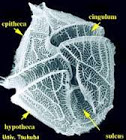
I already mentioned Flagellates  characterized by the possession of one or more flagella, which are long, tapering, hair-like appendages that act as organelles of locomotion. Among Flagellates a particularly interesting group are certainly Dinoflagellates  that are mostly part of the marine plankton, but also can be found in freshwater habitats.  They typically posses two flagella: a transverse flagellum running along an equatorial sulcus that beats to the cell's left, and a longitudinal flagellum, that beats posteriorly. Most are covered by a shell called lorica  often consisting of cellulose plates. They greatly differ from each other in shape and their size varies from 8 to 500 micrometers.


Lorica of a Dinoflagellate 


Ceratium

Many are autotrophs, i.e. they can produce its own food using light, water, carbon dioxide, or other chemicals thus, like plants, they are primary producer in the food chain.

Others are instead hetrotrophs so they need to eat.

Many of them are extremely voracious predators able to ingest very large preys. 

The species covered by a rigid lorica possess specific devices to capture and gulp down food organisms. Some  draw prey to the sulcal region of the cell (either via water currents set up by the flagella or via pseudopodial extensions) and ingest the prey through the sulcus.  Other species extrude a large feeding veil — a pseudopod called the pallium - to capture prey which is subsequently digested extracellularly  or  feed by attaching to its prey and ingesting prey cytoplasm through an extensible peduncle.


Dinophysis acuminata. Light micrographs of live cells feeding on a ciliate 

 Preys, attracted through chemical stimuli, are protists or even small  hurt metazoa. The latter can be co-digested by  a number of  predators.

Most planktonic dinoflagellates perform diurnal vertical migrations. In some cases the behaviour pattern is for the cells to migrate downwards away from the surface as the light becomes less intense and then to ascend again at the sunrise. In these migrations they  cover up to 50 meters.

Considering their size a distance corresponding to 4000 km for a human being!!!!

      The significance of this migration is understandable in autotrophic species needing light for their metabolism.

         But also a number of heterotophic species behave in the same way. Why?

The term plankton is a collective name for all marine and freshwater organisms nonmotile or too small or weak to swim against the current, existing in a drifting state. The term includes certain protists among which Dinoflagellates, bacteria, crustaceans, molluscs and coelenterates interacting in different ways; in particular prey-predators interactions influence reciprocal behaviours. Thus while small crustaceans, which are the main predators  of autotrophic or heterotrophic Dinoflagellates, migrate in the deepwaters during the day to prevent their own ingestion  from fishes and return to the surface in the night, it is possible that 
 Dinoflagellates migrate in the opposite sense to escape their engulfement.

 Anyway Dinoflagellate migration is a very important phenomenon in the planktonic ecosystem because it creates a massive biomass and nutrients shifting in the water column.

Dinoflagellates are the main eukaryotic protists that are capable of producing light. Within this group, bioluminescence is present in a number of ecologically important species, many of which like Noctiluca form blooms. When the organisms perceive the presence of a predator like for example a little crustacean, emit a flash of cold light lasting 0.1-0.5 seconds. The question is: why? Perhaps even this capacity is sophisticated defensive tool. Fishes that catch their food organisms on sight are attracted by the flash  and engulf the more visible crustacean allowing the protist to survive. 


 A bloom of a Noctiluca Dinoflagellate

Dinoflagellates are often responsible of red tides.

Red tides are common events in warm and polluted coastal oceans. They form when dinoflagellate algae explode to huge population levels. Because the dinoflagellates have red plastids, the waters literally turn redDinoflagellates take advantage of harsh environmental conditions that kill off other organisms.

Moreover they produce toxins that kill fishes or gather into filter feeding organisms such as mussels or clams and cause damage to molluscs eaters.


                                                                         Red tide


At present occurrence of red blooms is increasing all over the world.

The red tides in some locations appears to be entirely natural (algal blooms are a seasonal occurrence) while in others they appear to be a result of increased nutrient pollution from human activities increased temperature, alteration of ocean currents, increased  photosinthesis by elevated co2. 

Thus dinoflagellates that are under-known as fundamental planktonic components, primary producers and consumers of  the lower food chain levels, are instead infamous why in certain conditions, often caused by human beings, may became dangerous for human health.


Ops! I did not mentioned here that also Symbiodinium,  symbiont of coral polyps and not only, is a photosyntetic Dinoflagellate. I mentioned Symbiodinium in the post “Together we can” because their suffering, probably due to the temperature enhancement,  causes the suffering of coral reefs.


Anyway I would like to emphasize once again:


the relevance


of microorganisms in every ecosystem.


.


martedì 23 marzo 2021

Bioigegneria: l'ha già inventata la natura!!!


 Forse vale la pena di ricordare ancora una volta cosa sono i virus.

 Sono entità, non si possono definire organismi perché non sono in grado di riprodursi da soli, strutturalmente molto semplici costitute da un involucro proteico contenente una molecola di DNA o RNA.


Per potersi riprodurre aderiscono alle cellule bersaglio mediante le proteine esterne dell’involucro (recettori), quelle raffigurate come piccole ventose in tutte le coloratissime immagini del Sars-Cov2,
tra cui la proteina spike cioè la proteina
 che serve al virus per introdurre il suo DNA nelle cellule bersaglio, e iniettano nella cellula il loro genoma. Una volta dentro, il genoma virale si integra con quello cellulare, utilizza i meccanismi di replicazione del DNA, della trascrizione e traduzione della cellula ospite (suo malgrado!) e  in parole povere la costringono a riprodurlo.


Il nostro sars-cov2 al microscopio elettronico. Circa 60000x. IL virus non supera i 100 nm (nannometro = 1milionesimo di mm)


Così una particella virale, infettando una singola cellula, è in grado di produrre migliaia di discendenti.

Quello che mi ha sempre colpito nei miei studi è il fatto che tutto quello che inventa l’uomo in qualche modo lo ha già realizzato la natura. Infatti i virus, nella loro semplicità, sono dei veri e propri 

                                    bioingegneri 

che per risolvere i loro problemi modificano il DNA degli organismi proprio come gli scienziati che hanno prodotto gli OGM o cercano di curare le malattie genetiche.


Gli stessi vaccini che si stanno utilizzando contro il covid sono basati su tecniche di ingegneria genetica. 

Infatti non contengono il virus ucciso o attenuato ma modificano le cellule del sangue facendo loro produrre sostanze virali che attivano le cellule del  sistema immunitario a produrre anticorpi specifici.


 Il vaccino AstraZeneca è a vettore virale. Infatti sfrutta un altro virus, non dannoso ( un adenovirus derivato da uno scimpanzè), in cui è stato immesso solo il gene che  fornisce alle cellule del sangue le istruzioni necessarie per sintetizzare la proteina spike. Una volta prodotta, la proteina può stimolare una risposta immunitaria specifica contro di essa: se e quando il l’organismo venisse a contatto con il virus del covid  con le proteine spike esposte verrebbe subito respinto.


Il vaccino Pfyzer sfrutta invece un’altra tecnica, quella della biologia sintetica.

Infatti viene prodotto sinteticamente l’ RNA messaggero che trasmette l’istruzione per produrre la proteina Spike. Si tratta di una molecola piccola che, racchiusa in un piccolo lisosoma (vesciola di membrana lipidica),  viene facilmente assorbita nel citoplasma delle cellule del sangue. 


Le cellule saranno subito in grado di produrre la proteina Spike con conseguente attivazione del sistema immunitario che produrrà anticorpi contro di essa.


Non c’è quindi niente che faccia pensare a rischi di infezioni legati a questi vaccini che non utilizzano tecniche completamente nuove ma tecniche che già si stavano mettendo a punto per altri scopi: l’uso del vettore virale per la cura delle malattie ereditarie ,l‘RNA messaggero per la cura di tumori.

lunedì 18 maggio 2020

...LE AMEBE


Torniamo ai protisti.
Ho dedicato vari post ai ciliati di cui mi sono occupata direttamente nella mia attività di ricerca. Poi ho dedicato un post ai dinoflagellati ed uno ai foraminiferi. Si tratta in tutti i casi di protisti, quindi organismi unicellulari eucarioti, dalla forma ben definita di cui i generi, se non addirittura le specie, possono essere spesso identificate già con l’osservazione al microscopio ottico.

Diversa è la situazione delle AMEBE che sono invece protisti caratterizzati dalla variabilità della forma.
Quando la prima ameba fu osservata al microscopio venne chiamata “piccolo proteo” in ricordo di Proteo il dio greco multiforme.
Le amebe appartengono ai protisti Sarcodini rizopodi. Non hanno organi di movimento come ciglia o flagelli  e la loro membrana non è irrigidita da cuticole o altro. Si muovono emettendo dal corpo dei prolungamenti chiamati pseudopodi (alla lettera  falsi piedi). Se ricordate anche i Foraminiferi hanno pseudopodi, ma i loro sono lunghi, sottili, per poter uscire dai fori del guscio, spesso intrecciati e rafforzati da un assostilo interno. Per questo detti attinopodi). Gli pseudopodi delle amebe invece possono essere di varia forma e dimensioni, non hanno un rafforzamento interno (perciò rizopodi), vengono emessi e retratti da qualsiasi parte del corpo cellulare che quindi cambia continuamente forma. 


ameba 


 foraminifero                                                           


Protratti anteriormente gli pseudopodi aderiscono al substrato e trascinano in avanti tutta la cellula che procede così con il tipico movimento definito appunto ameboide.


Le amebe sono molto diffuse. Vivono in mare, in acqua dolce ed anche nei terreni umidi. Le loro dimensioni vanno da pochi micrometri fino a qualche millimetro. Possono essere nude” cioè prive di qualsiasi rivestimento o “tecate” cioè dotate di un guscio rigido di varia natura (calcio, silicio o anche agglomerati di materiali trovati nell’ambiente come granelli di sabbia, gusci di diatomee o altro). 


ameba tecata 


Le amebe sono eterotrofe e quindi, per vivere, devono mangiare. Non hanno un citostoma (bocca cellulare) o una qualche struttura per cibarsi in un posto fisso della cellula. 
Ma come fanno allora ad introdurre il cibo? 
Beh, gli pseudopodi servono anche per l’assunzione del cibo: si estendono a circondare  il possibile cibo e lo incamerano attraverso un processo di fagocitosi.


Ameba che ingloba un Paramecio (protista ciliato)


Si cibano di batteri, altri protisti ed anche detriti organici svolgendo così nell’ ambiente il ruolo di consumatori primari o secondari di piccole dimensioni che possono essere poi ingeriti da consumatori più grandi
Sono cioè parte integrante della catena alimentare.


Come altre caratteristiche che abbiamo descritto nei protisti, il movimento ameboide e la fagocitosi sono stati conservati, nel corso dell’evoluzione, in cellule specializzate di organismi pluricellulari, uomo compreso. Basta pensare ai macrofagi, cellule fagocitarie che svolgono un ruolo importante nel nostro sistema immunitario.

Ci sono anche amebe parassite, patogene ma quelle le lascio studiare agli esperti del settore.
Quelle che io posso dare sono informazioni sui protisti a vita libera. Non per niente ho tenuto per diversi anni il corso di Ecologia dei Protisti all’Università di Pisa.


lunedì 20 aprile 2020

and viruses?


Viruses are notorious, like a number of bacteria, as carriers of infectious diseases. Anyway while bacteria are sensible to antibiotics action, viruses are not.

Are viruses a different kind of microorganisms?

It is difficult to answer this question. Consider that in 2012 two different studies were published in the prestigious scientific journal “ Nature”. The first one entitled “Ten reasons to exclude viruses from the tree of life” and the second one entitled “Reasons to include viruses in the tree of life”

Even today viruses are thought of as being in a gray area between living and nonliving.

I can only give you some information.  They are generally smaller then every cell type ranging their size from 10- to 400 nm 
( millionths of a mm) and all are obligate intracellular parasites, Indeed viruses do not posses biochemical and biosynthetic structures for their replication.
All viruses contain nucleic acid, either DNA or RNA (but not both), and a protein coat, which encases the nucleic acid. 
Some viruses are also enclosed by an envelope of fat and protein molecules... 
The external coat contains special sites on its surface that allow the virus  to attach to a host cell, and provides proteins that enable the virus to penetrate the host cell membrane. 
Viral populations to grow use the machinery and metabolism of a host cell to produce multiple copies of themselves, and they assemble in the cell.....
So, when infected, the host cell is forced to rapidly produce thousands of identical copies of the original virus.
 Attachment is a specific binding between viral capsid proteins and specific receptors on the host cellular surface. This specificity determines the host range of a virus. ... This mechanism has evolved to favour those viruses that infect only cells in which they are capable of replication.
Unfortunately viruses are sometimes able to mutate and change their target cells.
   
Really in many cases nature is beyond imagining!!!

Indeed viruses behavior, whether they are living organisms or not, could give inspiration for science-fiction tales.

 Imagine, for example,  an alien intelligence  that, entering a body, makes maximum use of it up to its self-destruction.
 Or imagine an alternative program entering into the computer of a car factory forces the machinery to produce instead tanks?
Viruses act like this: Indeed we speak also  of computer viruses.

Digressions apart, why viruses are antibiotic-proof? Because antibiotics act deteriorating the bacterial metabolism but are ineffective on viruses because they  do not possess a their own metabolism!!

Only antibodies produced by the infected organism are able to counteract viruses: for this reason it is possible to recover from a viral disease, at present even from covid-19, without specific treatments (that there are not yet).
A vaccine is hoped for the latter new virus that, like all vaccines, could induce specific antibodies production from the target organisms allowing them to stop the virus entrance at the first contact.


sabato 28 marzo 2020

Aggiornamento sui virus

Anche i virus come i batteri sono tristemente noti come veicoli di malattie, ancora più subdoli dei batteri dal momento che sono resistenti agli antibiotici.


Ma cosa sono in realtà i virus: sono forse un altro tipo di microrganismi?


 Bella domanda!


Pensate che nel 2012 sono usciti, sulla prestigiosa rivista scientifica americana NATURE, due articoli di diversi importanti autori, intitolati rispettivamente:


"Dieci ragioni per escludere i virus dall'albero della vita"


e


 "Dieci buone ragioni per non escludere i virus dall'albero della vita".


In altre parole gli scienziati non erano e non sono ancora d'accordo se considerarli organismi viventi o no.


 Senza entrare nel merito della polemica, mi limiterò a fornirvi qualche informazione generale. 

 I  virus sono mediamente circa 100 volte più piccoli di una cellula (da 10 a 400 nanometri cioè millesimi di micron). Non possiedono tutte le strutture biochimiche e biosintetiche necessarie per la loro replicazione.  Essi consistono solo di: un genoma relativamente piccolo costituito da DNA o RNA e di una copertura proteica detta capside. Quest'ultima protegge l'acido nucleico virale; interviene nei processi di passaggio del virus all'ospite e determina le caratteristiche antigeniche del virus stesso. (cioè la capacità di riconoscere le cellule bersaglio e di essere riconosciute come estranei da queste). La replicazione virale può avvenire solo in cellule sensibili. La sensibilita’ è strettamente condizionata dalla presenza di adeguati recettori cellulari che permettono l’attacco del virus alla cellula ospite. Per questo in genere c’è una specificità tra virus e organismo infettato, anzi tra virus e tipo di cellule dell’organismo bersaglio.
     Alcuni virus hanno una seconda copertura, altri posseggono strutture molecolari specializzate ad iniettare il genoma virale  nella cellula ospite. Sono visibili soltanto al microscopio elettronico (ad almeno 40.000-50.000 ingrandimenti) ed hanno spesso una forma poliedrica regolare.

 Sono tutti parassiti obbligati e  per riprodursi  devono penetrare, o meglio, introdurre il proprio genoma in una cellula.

Una volta dentro, il genoma virale utilizza i meccanismi di replicazione del DNA, della trascrizione e traduzione della cellula ospite (suo malgrado!).

  In parole povere, i virus costringono la cellula a riprodurli, sulla base delle informazioni portate dal loro genoma. Così una particella virale (detta virione), infettando una singola cellula, è in grado di produrre migliaia di discendenti.

 Questa moltiplicazione virale è spesso sufficiente a uccidere la cellula ospite disintegrandola. Sicché  i nuovi virioni potranno spargersi andando a  infettare altre cellule.

Come vedete, in molti casi la natura supera la fantasia. Non vi pare che il comportamento dei virus, che siano organismi viventi o no,  potrebbe ispirare racconti di fantascienza?


 Immaginate ad esempio, una intelligenza estranea, magari venuta dallo spazio,  che penetrando in un corpo lo sfrutti al massimo per i propri scopi, costringendolo a comportarsi in modo anormale, fino a provocarne l'autodistruzione! 

Oppure un programma alternativo che, entrando nel computer di una fabbrica di automobili, costringa i macchinari a produrre carri armati? Non è altro che quello che fanno i virus!  (tra l'altro è per questo che si parla anche di virus informatici, anche se quella è un’altra faccenda).


Divagazioni a parte, perché i virus sono inattaccabili dagli antibiotici?

Perché gli antibiotici agiscono sul metabolismo dei batteri ma non possono funzionare su queste entità sprovviste, come detto,  di un loro   metabolismo autonomo. 

Solo gli anticorpi prodotti dall'organismo infettato possono neutralizzare il virus: per questo si può guarire dalla malattia, nel caso attuale dal covid-19, anche senza cure, che del resto non esistono. Un auspicabile vaccino, come tutti i vaccini, farebbe produrre gli anticorpi specifici in assenza di malattia bloccando così il virus fin dal primo contatto.
I
_

venerdì 28 febbraio 2020

Gli scienziati non parlano tra loro


Inquinamento, Effetto serra, Cambiamenti climatici, …. 
Si parla, si legge molto di queste cose come se si trattasse di un unico fenomeno sulle cui origini gli scienziati hanno pareri diversi. 

Ma proviamo a chiarirci meglio considerando i termini separatamente.

 Inquinamento: introduzione nell’ambiente di sostanze che possono danneggiare l’ambiente stesso e renderlo inadatto alla vita (vocabolario Zingarelli).
Che ai nostri giorni ci sia un notevole inquinamento dell’atmosfera e delle acque nessuno lo può negare!!! Lo smog nelle città, e non solo, lo vediamo e lo soffriamo tutti. Non solo i livelli attuali nell’atmosfera di anidride carbonica, metano e altri gas sono i più alti mai registrati, ma le “polveri sottili” cioè il pulviscolo di varia natura molto fine, talmente leggero da rimanere facilmente sospeso in aria e quindi respirato, sono letteralmente visibili perché formano una patina scura ovunque perfino sulla frutta matura. L’ inquinamento è certamente dovuto alle attività umane: uso di combustibili fossili ecc. Infatti è  più accentuato dove queste attività sono più intense.


Effetto serra: questo termine viene in genere usato in senso negativo. In realtà l'effetto serra, dovuto alla presenza nell’atmosfera di gas (compresa l’anidride carbonica) che trattengono parte delle radiazioni solari che giungono sulla terra, è essenziale per la presenza e lo sviluppo della vita.  Al contrario, l'aumento dell'effetto serra, che invece è causato dall'intervento dell'uomo sulla natura, quello che crea l’inquinamento di cui sopra, altera il normale equilibrio termico del pianeta.


Cambiamenti climatici: cioè le variazioni del clima della terra
 non sono
  una novità. 
    Ce ne sono stati in passato più o meno marcati (glaciazioni ecc. ) dovuti a vari fattori tra cui ‘attività solare" e composizione dell’atmosfera. Quindi può darsi che il cambiamento in atto, che non possiamo negare, rientri tra i cambiamenti “fisiologici” del nostro pianeta. 
 Però, visto che in questo caso si tratta di un aumento medio della temperatura, l’attività umana non fa che accelerare, amplificare questo processo.
Quindi le polemiche tra gli scienziati mi sembrano sterili: l’inquinamento e l’emissione dei gas che aumentano l’effetto serra, anche se non fossero l’unica causa della situazione attuale, vanno combattuti per non accelerare e potenziare i fenomeni derivati da questi cambiamenti.